
What Makes a Porta Potty ADA Compliant?
An ADA unit isn't just a bigger box. It has to hit specific dimensions and clearances, and Arden-Arcade Porta Pros builds every accessible unit to the same spec regardless of job size. The door opening needs a minimum clear width of 32 inches under ADA Standards section 404.2.3, wide enough for a wheelchair to pass without a fight. Inside, there has to be room for a 60 inch diameter turning circle per ADA Standards section 304.3.1, since a user needs to rotate a chair fully to reposition. The route leading up to the unit matters too: ADA Standards section 403.5.1 calls for a minimum clear width of 36 inches on the approach path, and the ground itself has to be stable, firm and slip resistant under ADA Standards section 302.1, which rules out loose gravel or soft turf as a landing pad. Grab bars, interior reach ranges, and door hardware all follow separate specs. Check the ADA accessible porta potty page for the full unit rundown, and compare it against the standard porta potty rental if you're trying to figure out how many of each type you need.
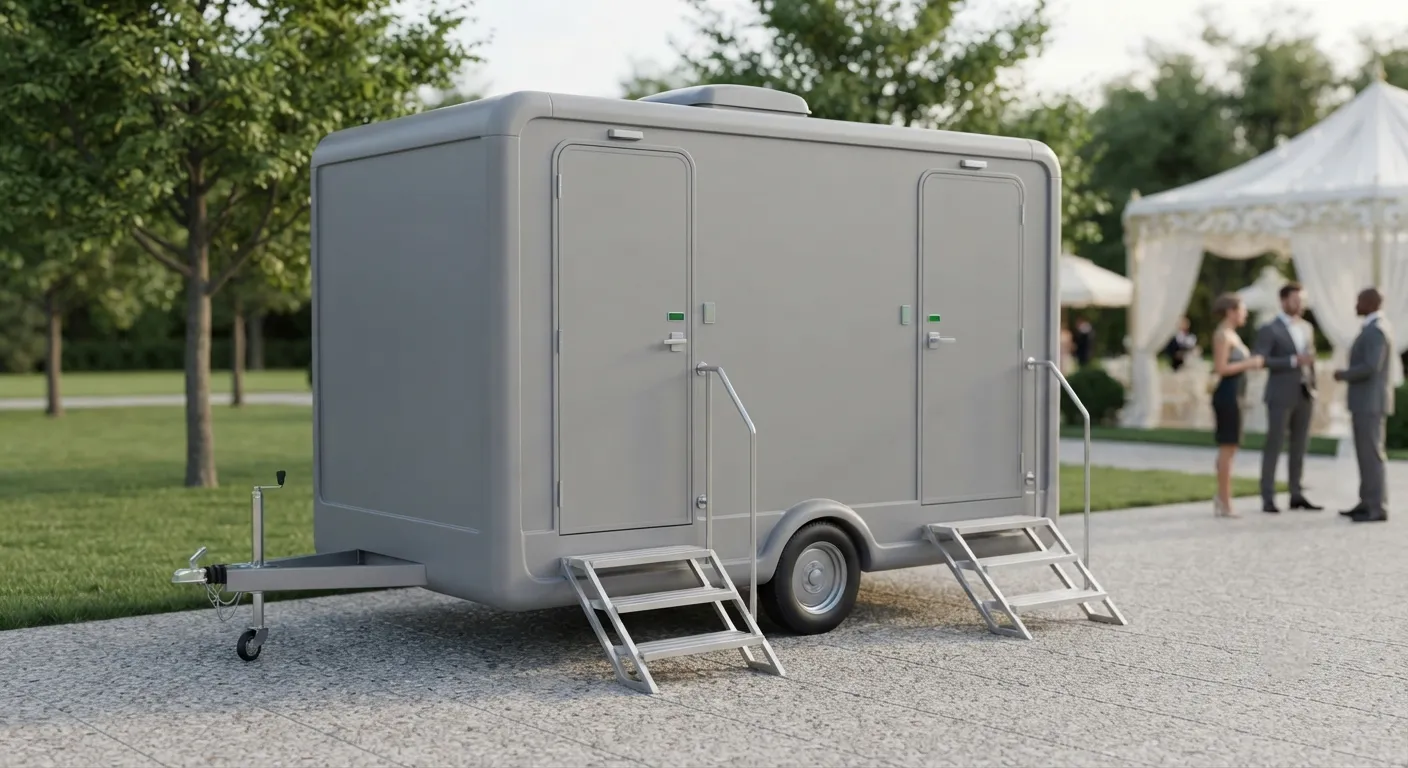
How Many ADA Units Do I Need in Arden-Arcade?
Start with the 5 percent rule from ADA Standards section 213.2, then round up. If you're placing 15 standard units for an event near Arden-Arcade, that math already puts you at one ADA unit minimum, and most planners add a second once foot traffic gets heavy. Construction sites layer this on top of OSHA 1926.51(c), which sets toilet ratios by crew size: one facility for 20 workers or fewer, then one toilet seat and one urinal per 40 workers as the crew grows past that, and one per 50 once you hit 200 or more. Neither OSHA nor the ADA table tells you exact placement distances for Arden-Arcade job sites, and that side of it needs confirming with the city before you finalize a layout. Our how many porta potties do I need guide walks through the arithmetic for mixed events, and the OSHA portable toilet requirements page breaks the worker ratios down further. If you're staging a race or festival with public access, cross check against our event restroom rental numbers, since public crowds don't follow OSHA's crew-based math the same way employees do.
Where Should ADA Units Be Placed on Site?
Placement has to satisfy the reach and force rules once someone is inside, not just the walk up. ADA Standards section 308.2.1 sets a forward reach range of 48 inches maximum and 15 inches minimum, which affects where paper dispensers and locks get mounted inside the unit. Operable parts like door latches have to work with one hand and no tight grasping or twisting, per ADA Standards section 309.4, with a 5 pound maximum force requirement, since a stiff latch defeats the purpose of an accessible unit. If your site has any grade change leading to the unit, a ramp can't exceed a 1:12 running slope under ADA Standards section 405.2, which means a foot of ramp for every inch of rise. On a sloped lot in Arden-Arcade, that adds up fast, and it's worth checking our porta potty placement guide before delivery day. Rosemont sites 4.9 miles southeast and La Riviera jobs 5.3 miles southeast run into the same grading questions on older lots, so this isn't unique to any one part of town. For larger footprints, our restroom trailer rental line includes ADA-ready trailer options that solve the ramp slope problem with a built-in ramp already engineered to spec.
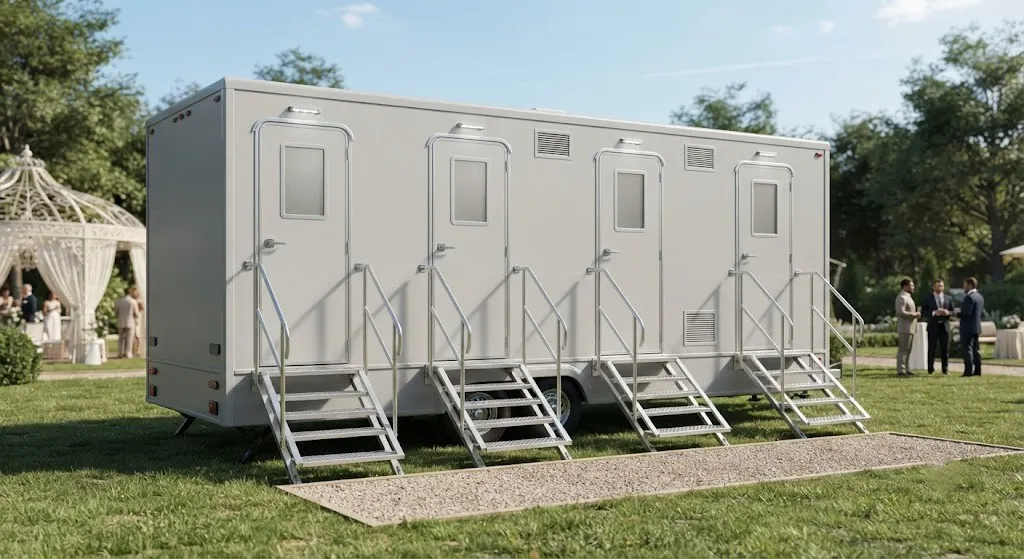
Does This Apply to Restroom Trailers Too?
Yes. Restroom trailers carry the same ADA obligations as single units once they're serving the public or a workforce, and the same section 213.2 clustering rule applies if you're mixing trailer stalls with standalone units. A 4 stall restroom trailer built for a wedding near Arden-Arcade still needs an accessible stall meeting the 32 inch door and 60 inch turning circle specs, and the interior route has to meet the same 36 inch clearance as a standalone unit. Larger events often lean on an 8 stall restroom trailer instead, but scaling up stall count doesn't waive the accessibility math. If you're renting for a construction crew rather than a public event, OSHA's general sanitation rule under 1926.51(c) still governs your toilet count regardless of whether the units sit in a trailer or stand alone, so budget your restroom trailer rental cost with that ratio in mind. Our luxury restroom trailer units include ADA stalls as standard on the larger models, which saves a separate unit rental.
Frequently asked questions
Is an ADA porta potty more expensive than a standard one?
Yes, ADA units run higher than standard ones. Day rentals typically land in the 200 to 400 dollar range, and weekly rentals typically run 120 to 240 dollars. See our porta potty rental cost page for the full breakdown by duration.
Can I mix ADA and standard units on the same site?
Yes, that's standard practice. Most Arden-Arcade events use mostly standard units with one or two ADA units mixed in to satisfy the 5 percent minimum under ADA Standards section 213.2. Talk to us about your headcount before ordering.
Do construction sites need ADA porta potties?
It depends on whether the public accesses the site. Worker-only sites follow OSHA 1926.51(c) ratios without an ADA mandate, but any public-facing construction project should include an accessible unit. Check our construction site services page for specifics.
What happens if my event doesn't have an ADA unit?
You risk noncompliance with ADA Standards section 213.2 and potential complaints from attendees who can't access facilities. It's cheaper to add one unit upfront than to scramble on event day. Request a quote early through our request a quote page.
Are ADA requirements different for a wedding versus a construction site?
The underlying ADA specs are the same, but the trigger differs. Public events like weddings need accessible units for guests, covered under our wedding restroom rental guidance, while job sites follow OSHA's worker-count ratios instead.
Next step
Get a delivery date
Tell us the address, the dates and the headcount. We size the order and confirm the route.